
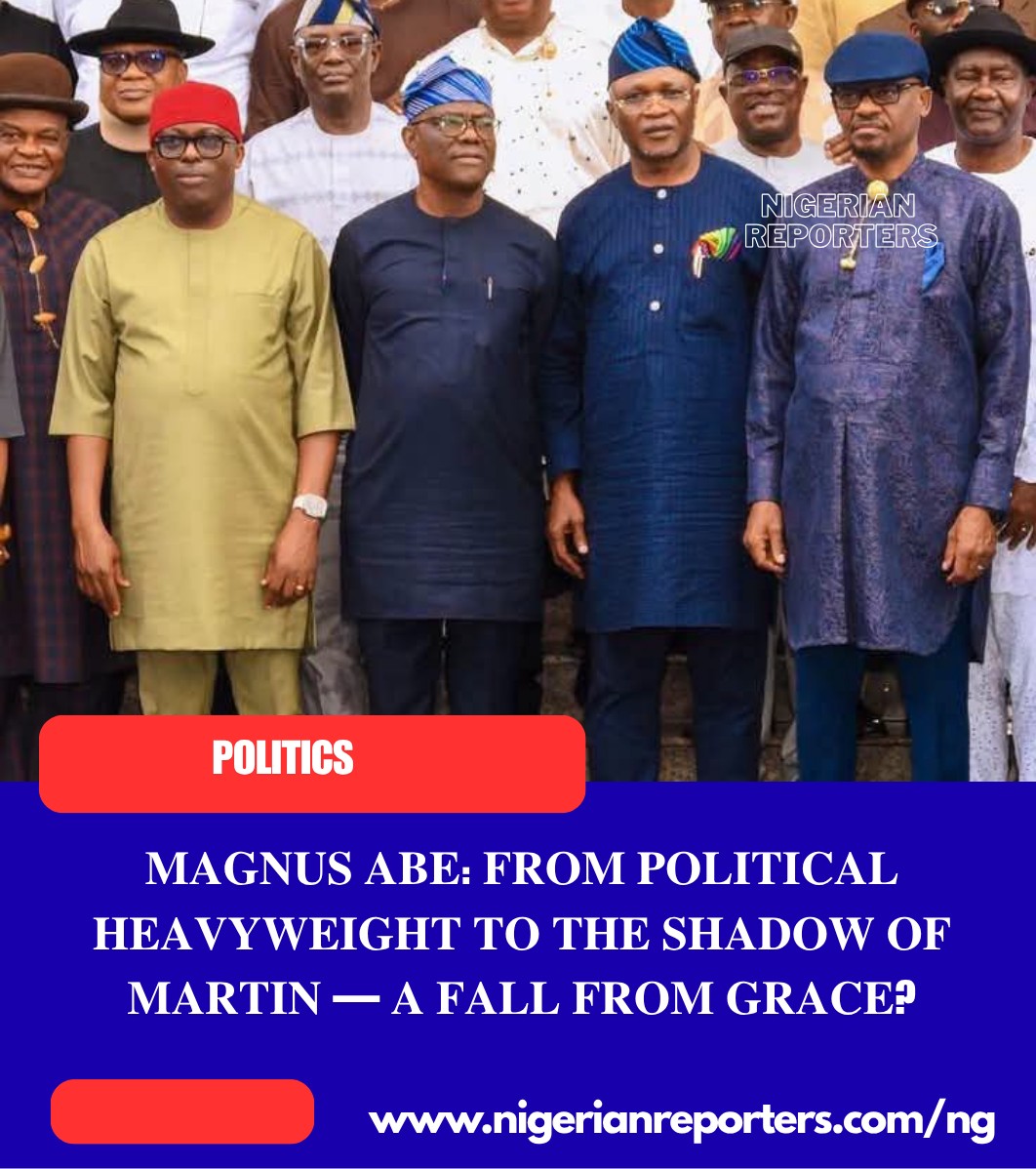
In politics, the greatest measure of a man’s influence is not the number of titles he has accumulated, but the extent to which his voice commands attention, his decisions shape events, and his presence influences the direction of political conversations.
By that measure, the political journey of Magnus Abe raises an important question: What has become of a man who once stood firmly in the centre of Rivers State politics but now appears increasingly comfortable playing a supporting role?
A former senator, former Secretary to the Rivers State Government , former state lawmaker, and governorship candidate, Abe is no political novice. His resume reflects years of political engagement, strategic positioning, and participation in some of the most consequential political battles in Rivers State.
He was once a formidable political figure whose voice carried weight and whose ambitions extended beyond the margins of political relevance. He occupied influential positions, contested for the state’s highest political office, and established himself as a prominent player in the state’s political landscape.
Yet, today, the image emerging from his association with Martin raises questions about the direction of his political journey and the extent to which he retains the independence and influence that once defined his public profile.
For a man with Abe’s political pedigree, the optics are difficult to ignore.
The Burden of a Glorious Political Past
Magnus Abe’s political history is one of considerable achievement. He has occupied positions that many politicians spend their entire careers aspiring to attain. His experience in the legislature and the executive arm of government gave him access to the corridors of power and an opportunity to shape the political conversation in Rivers State.
His governorship ambition further demonstrated that he was not content with merely occupying the background. He wanted to lead, to influence the direction of governance, and to determine the political future of the state.
That history makes his present political positioning particularly intriguing.
When a politician who once aspired to lead an entire state appears to be operating in another person’s shadow, observers are bound to ask questions. Has his political strategy changed? Has he recalibrated his ambitions? Or has the pursuit of political relevance gradually taken precedence over the independence that once distinguished him?
These are questions that deserve serious consideration.
When Influence Gives Way to Political Convenience
Politics is an unforgiving arena. Alliances shift, fortunes change, and yesterday’s power brokers sometimes find themselves negotiating for space in arrangements they might once have expected to lead.
There is nothing inherently wrong with political alliances. Experienced politicians frequently collaborate with others to advance shared interests, influence policy, or remain relevant in an evolving political environment.
The problem arises when an alliance appears to diminish rather than strengthen the standing of one of its participants.
In Abe’s case, the concern is not simply his association with Martin. It is the perception that a politician of his experience and former stature may be settling for a role that does not adequately reflect his political pedigree.
A man who once sought to govern Rivers State inevitably invites scrutiny when he appears content to occupy a subordinate position in another political figure’s orbit.
The question, therefore, is not whether Magnus Abe has the right to support Martin. He unquestionably has that right. The more consequential question is whether this political alignment enhances his influence or gradually reduces him to a supporting character in a story he once hoped to lead.
The Price of Political Survival
Political survival often demands compromise. Sometimes, those compromises are strategic and necessary. At other times, they can come at the expense of a politician’s independence, credibility, and long-term relevance.
The danger for a figure like Abe is that the pursuit of immediate political accommodation may overshadow the legacy he spent years building.
Political appointments can provide access to power, but access is not the same as influence. Being close to decision-makers does not necessarily mean having the authority to shape decisions. Equally, occupying a position within a political arrangement does not automatically translate into maintaining an independent political identity.
For a politician with Abe’s experience, the challenge should be to demonstrate that his present alliances serve a larger political purpose rather than merely preserve a place within the establishment.
Otherwise, the contrast between his former stature and his current positioning will continue to fuel speculation about the direction of his political career.
Has Magnus Abe Traded His Political Independence?
One of the most persistent criticisms of politicians who move from prominent leadership ambitions into subordinate political arrangements is that they risk surrendering the very independence that made them influential in the first place.
In Abe’s case, the perception that he may have exchanged a more autonomous political position for the benefits of political accommodation raises questions about his priorities.
Has he made a calculated strategic move, positioning himself for a future opportunity? Or has the desire to remain relevant in the present gradually displaced the ambition to exercise independent political influence?
Without a clear explanation of his long-term political objectives, both interpretations will remain part of the public debate.
But one principle remains relevant: political relevance sustained by association is not necessarily the same as political influence earned through independent authority.
The former can disappear when alliances collapse. The latter is built on a political base, a clear identity, and the ability to command attention regardless of who occupies the centre of power.
A Legacy at a Crossroads
Magnus Abe’s political journey is not necessarily over. Politics is fluid, and today’s subordinate figure can become tomorrow’s principal actor. A strategic alliance that appears disadvantageous in the present may yet produce dividends in the future.
However, that possibility does not eliminate the questions surrounding his current political posture.
For a former senator, former SSG, former state lawmaker, and governorship candidate, the expectations are naturally higher. His political history places him in a category of public figures whose decisions are measured not merely by their immediate benefits but also by their implications for their long-term standing.
The challenge before Abe is to demonstrate that his present choices represent a deliberate political strategy rather than a gradual retreat from the influence he once commanded.
He must show that he remains a political actor with his own convictions, ambitions, and capacity to shape events, rather than a figure whose relevance is increasingly defined by his proximity to another man.
Ultimately, political history remembers more than the offices a man has occupied. It also remembers whether he used those positions to establish an enduring political identity or gradually surrendered that identity in the pursuit of continued access to power.
For Magnus Abe, the question is no longer simply what he has achieved in the past.
And in the unforgiving theatre of Rivers State politics, that is a question his supporters, critics, and political observers will continue to ask.