
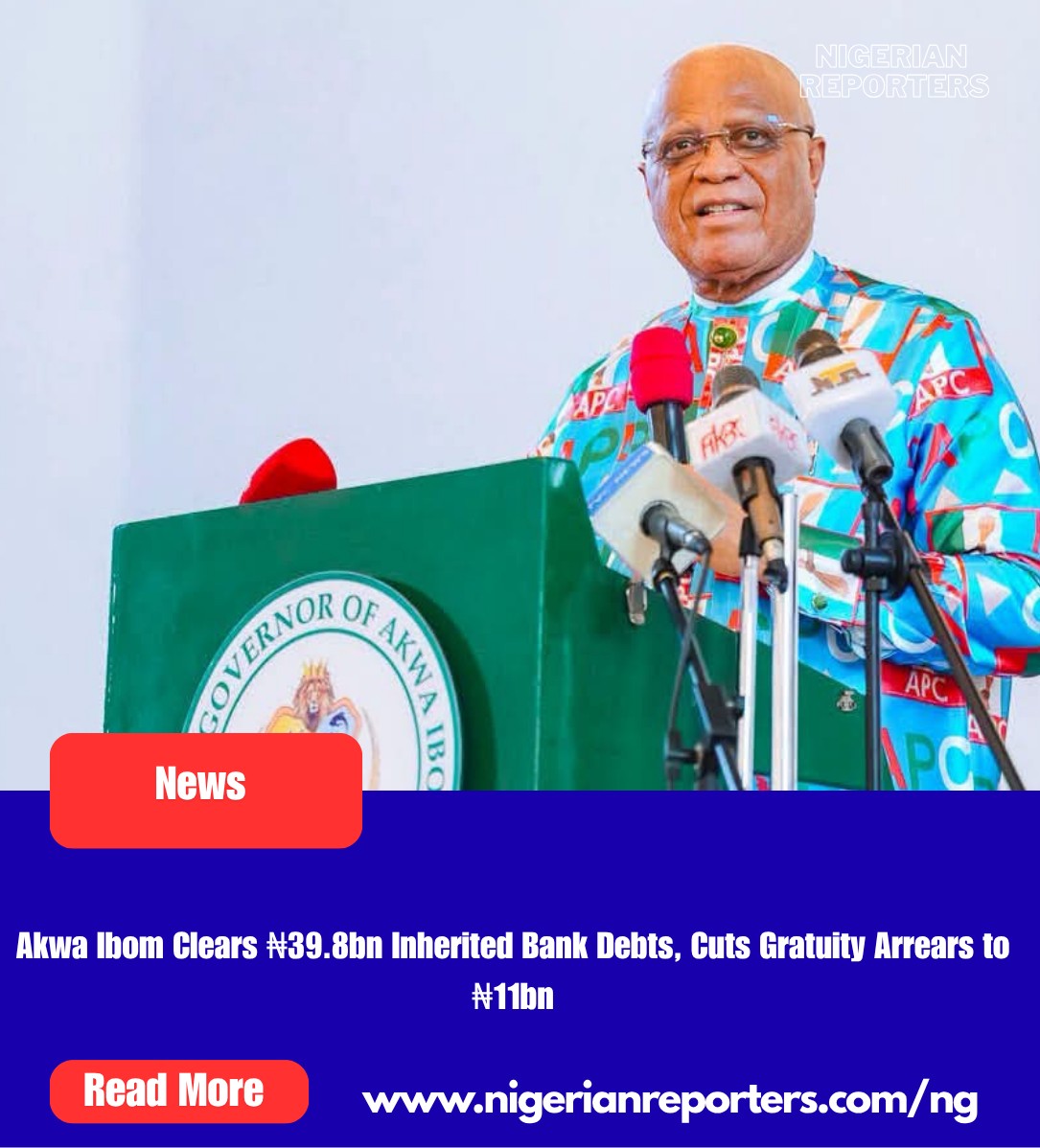
The Akwa Ibom State Government has cleared ₦39.8 billion in inherited commercial bank debts and reduced its gratuity backlog from ₦111 billion to ₦11 billion, representing a 90 per cent reduction.
The Commissioner for Finance, Mr Emem Bob Almond Bob, disclosed this during a ministerial media briefing in Uyo, where he presented the achievements and financial management reforms of the Ministry of Finance under Governor Umo Eno’s administration.
Bob said the clearance of the inherited bank obligations, comprising principal and accrued interest, had strengthened the state’s financial position and improved its capacity to meet other financial commitments and sustain essential services.
He expressed optimism that the remaining ₦11 billion gratuity arrears would be cleared soon, adding that the government intended to ensure retirees receive their gratuities as they leave service from the administration’s second term.
On workers’ welfare, the commissioner disclosed that the state had disbursed ₦386.6 million in housing loans to 429 civil servants, while another ₦101.448 million had been earmarked for 63 additional qualified beneficiaries.
He said salaries and pensions were being paid promptly across Ministries, Departments and Agencies, adding that payment of the 2026 leave grant commenced with the September salary.
Providing an update on the inherited credit facility granted to Ibom Power Company Limited by the African Export-Import Bank (Afreximbank), Bob said the outstanding debt had been reduced from US$7.805 million to US$3.005 million as of September 2026.
He also revealed that the state’s investment portfolio under the custody of the Ministry of Finance Incorporated had increased from ₦6 billion to ₦11.193 billion, generating approximately ₦470.258 million in returns as of September 2026.
According to him, the state recently acquired ₦150 million worth of Dangote Refinery shares through a private offer as part of efforts to diversify and strengthen its investment portfolio.
On business reforms, Bob announced that Akwa Ibom had secured US$9.785 million in performance-based funding under the World Bank-supported State Action on Business Enabling Reforms (SABER) programme.
He attributed the achievement to the implementation of the state’s Business Enabling Reforms Action Plan (BERAP), which seeks to improve the business environment, attract private investment and create employment opportunities.
The commissioner further disclosed that the Ministry had fully implemented the Treasury Single Account (TSA) for Internally Generated Revenue from January 1, 2026, alongside the expansion of electronic revenue collection through AkwaRemit.
He explained that the reforms were designed to strengthen revenue monitoring, eliminate leakages, harmonise collection processes and improve accountability in government revenue generation.
Bob stressed that improved revenue mobilisation was not intended to impose arbitrary financial burdens on residents and businesses but to establish a fair, efficient and transparent collection system.
On institutional reforms, he said the Ministry had facilitated amendments to the State Public Procurement Law and the Fiscal Responsibility Law to strengthen regulatory institutions and align their operations with current realities.
He added that the state had sustained the publication of audited financial statements for 2023, 2024 and 2025, alongside Citizens Accountability Reports, Fiscal Responsibility Board Annual Reports, Debt Sustainability Analyses and Quarterly Debt Profiles.
The commissioner explained that although the Ministry of Finance does not directly execute infrastructure projects, it provides the financial framework for their implementation and sustainability by ensuring that government commitments are properly evaluated, funded and managed in line with available resources.
Meanwhile, the Commissioner for Budget and Economic Planning, Dr Nsikan Linus Nkan, disclosed that 16,950 residents had benefited from conditional social transfers under the Akwa Ibom State COVID-19 Action Recovery and Economic Stimulus (AK-CARES) programme.
Nkan, who also spoke at the briefing, said 15,660 residents had benefited from labour-intensive public works, while 10,408 people received livelihood grants.
He added that 118 micro-projects had reached approximately 153,288 residents, while 76 rural roads were rehabilitated to improve connectivity and stimulate economic activities in rural communities.
Other interventions under the programme included the distribution of agricultural assets to 12,309 residents, the upgrading of 28 wet markets and the provision of grants to 3,562 small-business operators.
On the state’s budget performance, Nkan said Akwa Ibom recorded 86.6 per cent performance in 2023, while revenue generation in 2024 exceeded projections by 15 per cent, representing 115 per cent of the estimated target.
He explained that the state’s budget increased from a revised ₦850 billion in 2023 to ₦923.4 billion in 2024, with expenditure performance standing at 69.2 per cent based on actual revenue.
According to him, budget performance reached 84.4 per cent in 2025, while the ₦1.5 trillion 2026 budget recorded 64.6 per cent performance between January and September.
Nkan attributed the improved performance partly to the establishment of the Ministry of Budget and Economic Planning, which coordinates budgeting and economic planning to ensure effective allocation and utilisation of public resources.
He said the Ministry also coordinates the Medium Term Expenditure Framework, monitors revenue generation and oversees development partnerships to strengthen fiscal planning, transparency and accountability.