

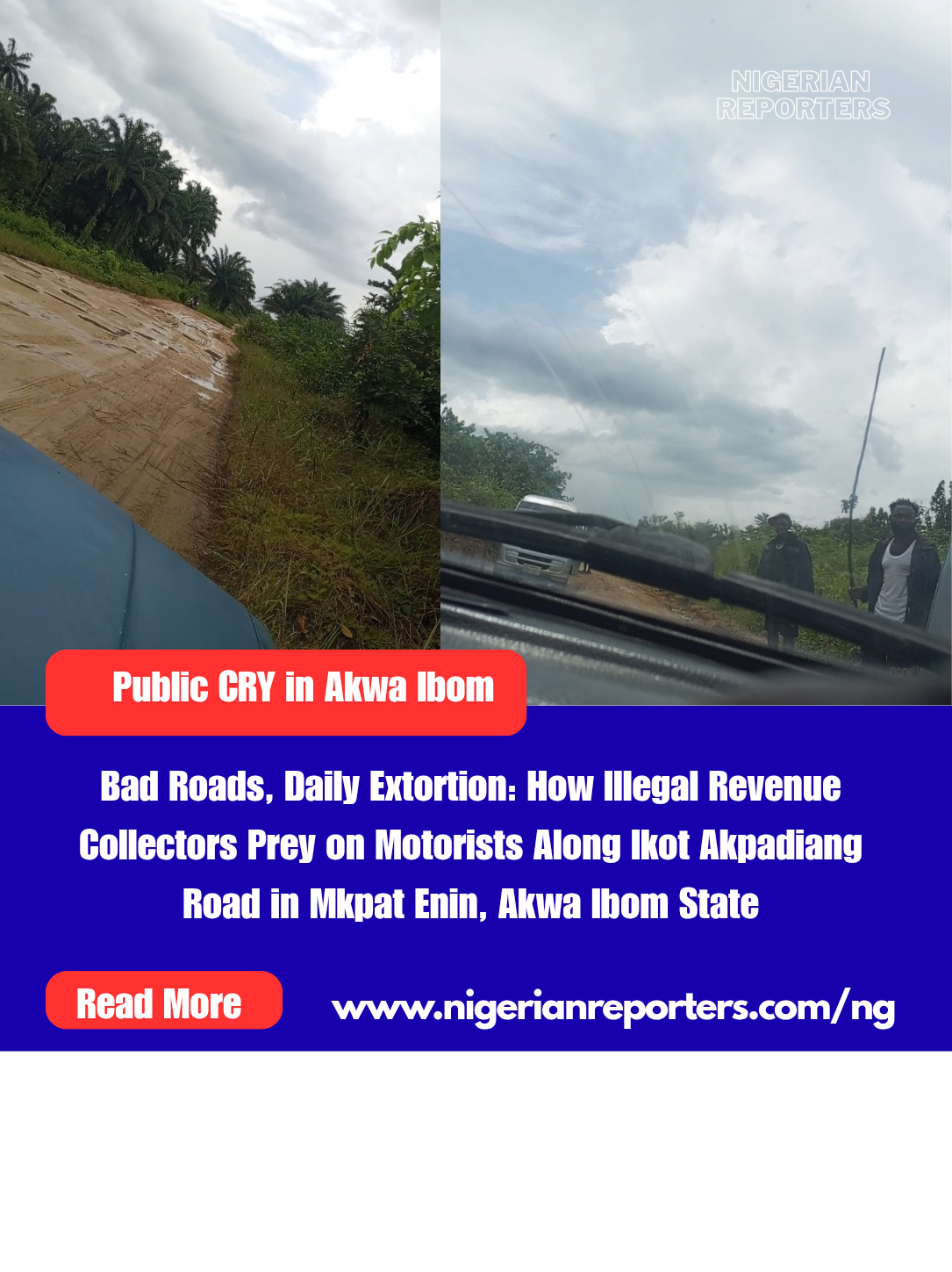
Motorists travelling along Ikot Akpadiang Road in Mkpat Enin Local Government Area of Akwa Ibom State have raised concerns over alleged multiple revenue collection points mounted by individuals whose authority to impose the levies remains unclear, adding to the financial burden of road users already grappling with poor road conditions.
The journey along Ikot Akpadiang Road in Mkpat Enin Local Government Area of Akwa Ibom State is increasingly becoming a source of frustration for motorists, traders and commuters who depend on the route for their daily activities.
Beyond the challenges posed by the condition of the road, road users have raised concerns over the activities of individuals allegedly collecting money at multiple checkpoints along the route linking Mkpat Enin Local Government Area to Ikot Abasi Local Government Area.
The collections, which appear to vary depending on the checkpoint, the number of passengers and the loads being transported, have sparked questions about the legality of the levies, the identity of those collecting them and the authorities responsible for regulating revenue collection along the road.
For commercial drivers who ply the route regularly, the issue is more than an inconvenience. It is an additional financial burden that threatens their daily earnings and raises concerns about the welfare of passengers who ultimately bear part of the cost.
Three checkpoints, multiple demands
Observations along the road indicate the presence of three alleged revenue collection points, reportedly mounted by individuals believed to be members of the surrounding communities.
At the first checkpoint, motorists are reportedly expected to pay N200. At the second and third points, the amounts are said to be less fixed, ranging from N300 to N500, depending on the load being conveyed and the number of passengers in a vehicle.
However, establishing the legality of the levies would require verification from the relevant local government authorities and the identification of any permits, receipts or official directives authorising the collections.
For now, the central concern among road users is straightforward: who authorised the checkpoints, where does the money go, and what mechanism exists to hold those collecting it accountable?
An atmosphere of fear and uncertainty
Beyond the financial demands, concerns have also been raised about the environment around some of the checkpoints.
Packets associated with cigarettes and other substances, as well as machetes reportedly seen around one of the locations, have contributed to a sense of unease among some commuters.
‘There is no time I pass that I don’t pay’
For drivers who use the road repeatedly, the alleged collections represent a recurring expense that can accumulate over the course of a working day.
One commercial driver who operates between Ekom Iman and Ikot Abasi Park described the situation as increasingly frustrating, lamenting the repeated payments demanded whenever he travels along the route.
“I’m tired. I drive from Ekom Iman to Ikot Abasi Park and back to Ekom Iman. There’s no single time I pass that I don’t pay these people. It’s becoming something else,” he said.
His account reflects the concerns of commercial operators whose earnings depend on making multiple trips while managing fuel costs, vehicle maintenance and other operating expenses.
Some road users have questioned what their representatives in the House of Representatives and the Senate are doing to address the situation, particularly given the route’s importance to communities and commercial activities in the area.
Their concerns reflect a broader demand for representation that goes beyond political campaigns and public statements to include practical intervention when residents report problems affecting their daily lives.
Yet responsibility for investigating the alleged collections should not rest on elected representatives alone. The relevant local government administration, appropriate revenue authorities and law enforcement agencies all have roles to play in determining whether the checkpoints are lawful and whether any misconduct has occurred.
For traders moving goods, transport operators ferrying passengers and residents travelling between communities, the road is an essential connection to markets, workplaces and other economic opportunities.
When travel along such a route comes with repeated demands for money, road users may be left questioning whether the cost of movement is becoming unnecessarily high.
The concern is particularly pressing for commercial drivers, who cannot easily avoid the route if it is central to their daily operations.
Each additional payment, however small it may appear in isolation, becomes significant when repeated across multiple checkpoints and several trips.
The government therefore faces two related challenges: ensuring that the road receives the attention its users need and establishing effective oversight of any revenue collection taking place along it.
Addressing one without the other would leave road users exposed to some of the same difficulties that prompted their complaints.
For the driver travelling between Ekom Iman and Ikot Abasi Park, however, the immediate concern is more personal: making another trip without being subjected to repeated payments that he says have become exhausting.
His complaint captures the frustration of road users who want to move freely, conduct their businesses and earn a living without facing avoidable financial pressure.
Until the relevant authorities investigate the allegations and explain the legal status of the checkpoints, uncertainty will continue to surround the collections.
For the people who depend on Ikot Akpadiang Road, the demand is clear: transparent revenue administration, safe passage, improved road conditions and decisive government action where wrongdoing is established.
Video showing those who extort money from drivers