

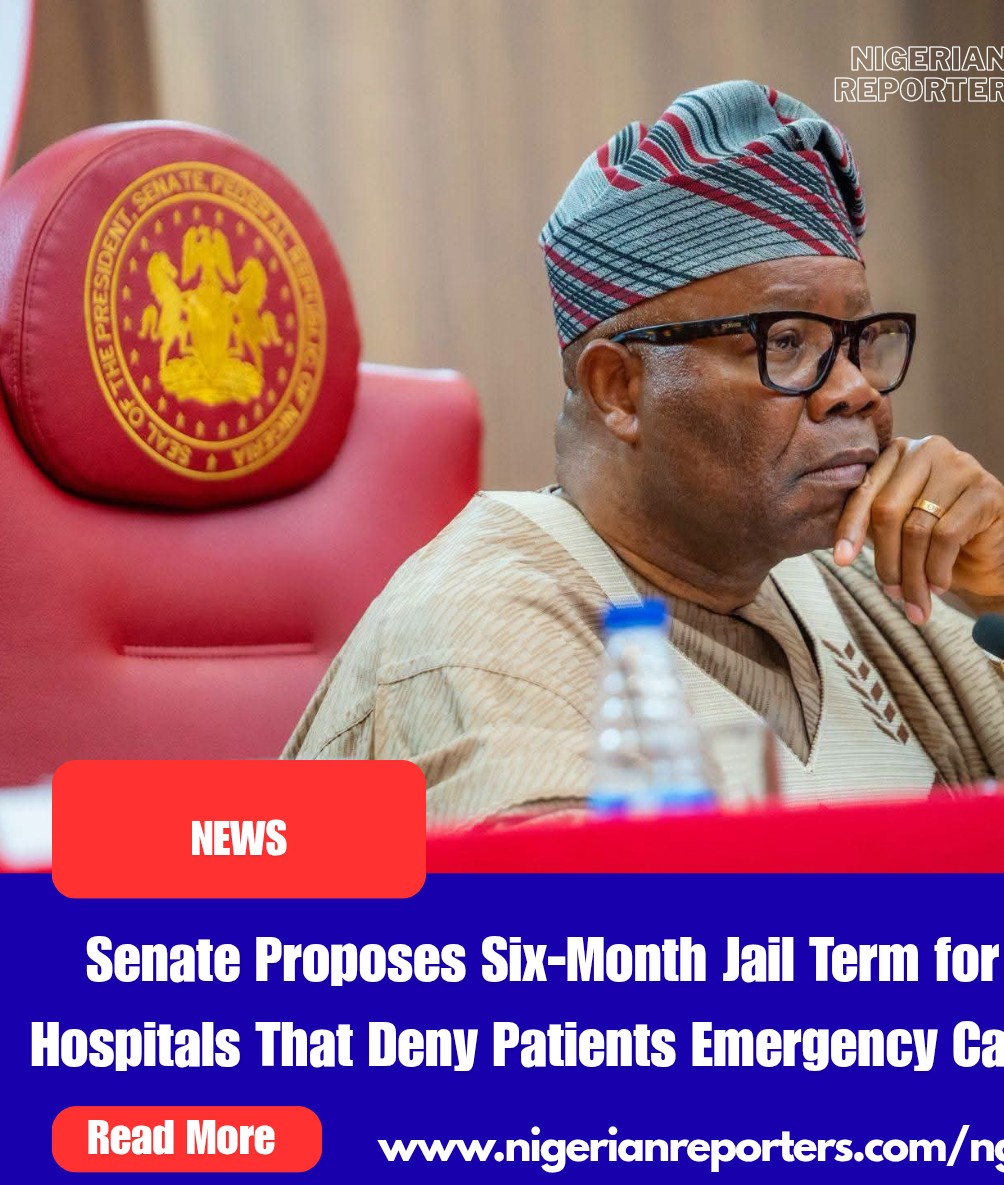
The Nigerian Senate has passed for second reading a bill seeking to make emergency medical treatment compulsory in public and private hospitals across the country, proposing a six-month jail term and a fine of up to N300,000 for anyone found guilty of denying patients emergency care.
The proposed legislation, sponsored by Senator Abdulaziz Musa Yar’Adua of APC, Katsina Central , seeks to amend the National Health Act, 2014, to establish mandatory emergency medical treatment standards and referral protocols in healthcare facilities.
The bill, titled “A Bill for an Act to Amend the National Health Act, 2014 to Provide for Emergency Medical Treatment Standards and Referral Protocols in Healthcare Facilities; and for Related Matters, 2026” (SB. 759), was referred to the Senate Committee on Health (Secondary and Tertiary) for further legislative action. The committee was given four weeks to report back.
Under the proposed amendment, hospitals, healthcare providers and medical personnel would be prohibited from denying patients emergency medical treatment for any reason.
The bill also requires healthcare professionals to immediately commence life saving interventions, including cardiopulmonary resuscitation, airway management and bleeding control, once a life-threatening condition is identified.
It further proposes that hospitals conduct triage and initial assessments within 15 minutes of a patient’s arrival, while basic stabilisation measures, including oxygen administration, intravenous fluids, pain management and initial diagnostic procedures, must begin within 30 minutes.
For patients requiring admission, hospital beds are expected to be assigned within two hours, subject to availability. Where no bed is available, the facility must immediately stabilise the patient and arrange a transfer to another hospital.
The proposed law also requires hospitals to initiate referral arrangements within two hours and complete transfers within three hours of a patient’s arrival, except where circumstances beyond their control prevent compliance.
Hospitals would also be required to dispatch an ambulance or arrange alternative transportation within 30 minutes of communicating a referral decision.
In addition, the legislation seeks to introduce mandatory emergency care training and certification for healthcare workers, with recertification required at intervals not exceeding 18 months.
It also mandates the Medical and Dental Council of Nigeria and the Nursing and Midwifery Council of Nigeria to jointly develop a standardised national emergency care curriculum.
Apparently, healthcare practitioners would be exempted from penalties where resource constraints prevent them from meeting the proposed requirements, provided such limitations are properly documented and prescribed referral procedures are followed.
Leading the debate on the bill, Yar’Adua said the proposed amendment would address critical gaps in Nigeria’s healthcare system by establishing enforceable standards for emergency treatment and referral procedures.
He said the legislation would help guarantee timely, life-saving medical attention to Nigerians during emergencies, regardless of their social status, financial capacity, influence or location.
According to the senator, preventable deaths continue to occur because many healthcare facilities lack clearly defined and enforceable timelines for patient assessment, stabilisation and treatment.
He also cited Nigeria’s contribution to approximately 10 per cent of global maternal deaths, attributing part of the problem to delays in accessing emergency obstetric care.
Yar’Adua said the proposed amendment would improve coordination among primary, secondary and tertiary healthcare facilities, while ensuring that patients are stabilised before being transferred to other hospitals.
He added that the bill would protect healthcare workers acting in good faith under documented resource limitations while ensuring accountability for wilful negligence.
The senator noted that the proposed legislation was consistent with international practices, citing Ghana, South Africa, Kenya, the United Kingdom and the United States as examples.
However, Senator Francis Faduyile of APC, Ondo South expressed concerns about the proposed criminal penalties, warning that healthcare professionals should not be held criminally responsible without first addressing challenges such as inadequate facilities, personnel shortages and insufficient medical equipment.
Faduyile said many hospitals lacked enough doctors, oxygen cylinders and emergency equipment to meet the proposed timelines.
He questioned how a doctor attending to several patients simultaneously could be held criminally responsible when another emergency case arrived.
Senator Faduyile also raised concerns about inadequate funding, noting that private healthcare providers often treat emergency patients without receiving reimbursement for the services.