

The Alleged Substitution of Victor Akpan Raises Serious Questions About Internal Democracy in NDC
Can a political party credibly preach democracy to Nigerians when allegations of irregularities in its own candidate selection process remain unanswered?
Can a party that seeks the people’s mandate demonstrate fairness, transparency, and accountability within its own ranks?
These are fundamental questions that the leadership of the Nigeria Democratic Congress, particularly its Akwa Ibom State chapter, must address following a complaint by Comr. Victor Akpan over the reported substitution of his name as the party’s candidate for the Nsit Atai State House of Assembly Constituency.
The controversy has placed the party’s commitment to internal democracy under public scrutiny and raises an important question: Is the Nigeria Democratic Congress truly a political party of integrity, or is it at risk of becoming another platform where the interests of powerful individuals outweigh established rules and democratic principles?
THE PRIMARY ELECTION CONTROVERSY: WHAT HAPPENED?
According to a statement by Comr. Victor Akpan, he participated in the NDC primary election for the Nsit Atai State Constituency on 29 May 2026 as the sole aspirant and maintains that he emerged as the duly elected candidate.
Akpan further claims that the primary election result was signed by the NDC State Chairman and submitted to the Independent National Electoral Commission.
However, he alleges that his name was subsequently omitted and that another individual, Elijah Essang Udontuk, was presented as the party’s candidate.
It raise serious questions that demand transparent answers from the party’s leadership.
Why would a party conduct a primary election, document its outcome, and submit the result to the electoral umpire, only for a different individual to reportedly emerge as its candidate?
Was there a lawful basis for the reported substitution?
Were the party’s nomination procedures followed? Was the original result invalidated, and if so, by whom and on what grounds?
These questions cannot be dismissed as mere political disagreements. They concern the credibility of the party’s internal processes and the confidence members and voters can place in its leadership.
THE DOCUMENT THAT COULD SETTLE THE CONTROVERSY
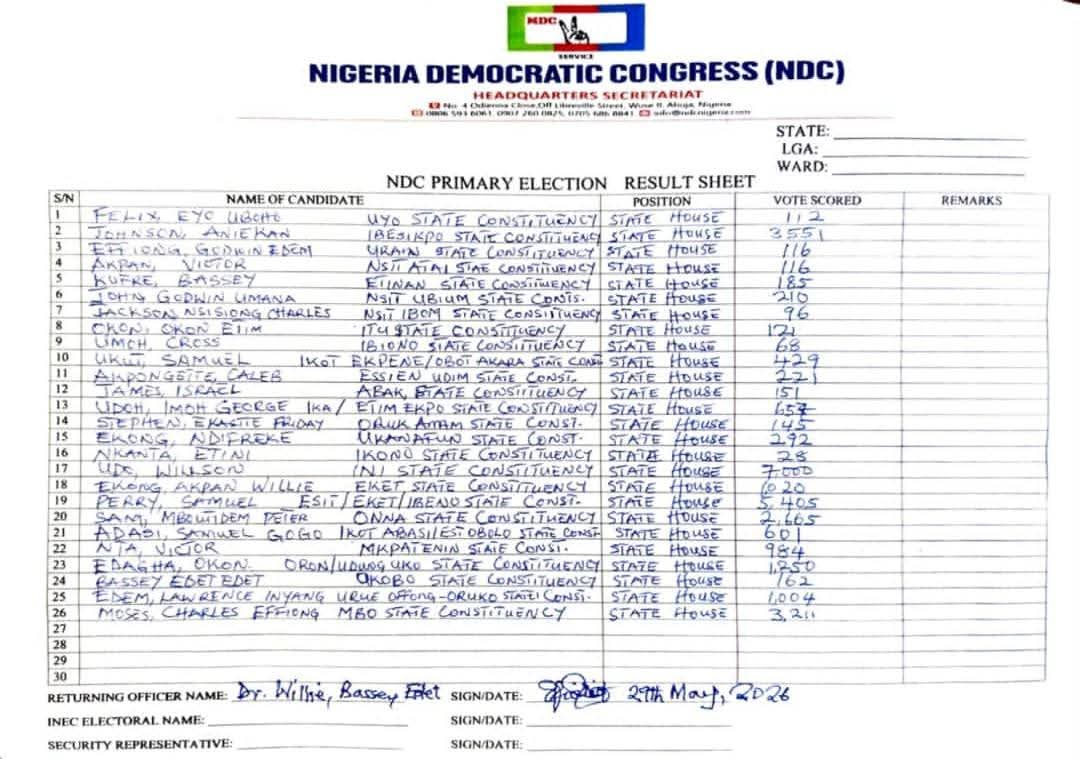
At the centre of Akpan’s complaint is the alleged primary election result bearing the signature of the NDC State Chairman.
If such a document exists as described, its authenticity, contents, submission history, and legal significance are critical to resolving the dispute.
The party should clarify whether the document was officially issued and submitted to INEC, whether any subsequent decision affected its validity, and what documentary evidence supports the nomination of the alternative candidate.
The public also deserves clarification on whether the alternative candidate participated in a primary election and, if so, whether the process complied with the party’s constitution, nomination guidelines, and applicable electoral law.
If the process was transparent, the documents should provide clarity. If a mistake occurred, the party should explain how it happened. And if the rules were breached, appropriate corrective action should follow the law.
Nevertheless, fairness requires that all parties be heard and that the relevant documents be independently examined before conclusions are drawn about wrongdoing.
WHAT DOES THE LAW SAY ABOUT PARTY PRIMARIES?
Nigeria’s Electoral Act 2026 contains provisions governing political party primaries and the nomination of candidates, including Section 84, subject to applicable amendments and other relevant legal provisions.
Section 84 Electoral Act 2026
Section 84 of the Nigerian Electoral Act 2026 is about Nomination of candidates by parties. It provides as follows:
(1) A political party seeking to nominate candidates for elections under this Act shall hold primaries for aspirants to all elective positions which shall be monitored
by the Commission.
(2) The procedure for the nomination of candidates by political parties for the
various elective positions shall be by direct primaries or consensus.
Political parties are expected to conduct their nomination processes in accordance with the law and their own governing rules.
Where a dispute arises over a candidate’s emergence, the relevant questions include whether the prescribed process was followed, whether the party acted within its lawful authority, and whether the available evidence supports the nomination it submitted to INEC.
The precise legal consequences of an alleged substitution depend on the facts, the applicable law, the relevant deadlines, and any decisions made by the competent authorities or courts.
Consequently, the NDC leadership should not treat Akpan’s complaint as an inconvenience to be ignored. It should treat it as an opportunity to demonstrate that the party’s commitment to democracy extends beyond political speeches and campaign slogans.
A PARTY’S INTEGRITY BEGINS WITH HOW IT TREATS ITS OWN MEMBERS
Political integrity is not measured by the number of rallies a party holds, the promises its leaders make, or the popularity of its candidates.
It is measured by how faithfully the party observes its own rules, how transparently it resolves disputes, and how willing its leadership is to submit its decisions to scrutiny.
A party that demands accountability from public officeholders must be prepared to account for its own actions.
A party that calls for electoral justice must demonstrate fairness in selecting its candidates.
And a party that asks Nigerians to trust its promises must show that the votes and aspirations of its members matter.
The controversy surrounding the Nsit Atai nomination therefore presents the NDC with a defining test. Its response could strengthen confidence in its internal democratic structures or deepen concerns about the credibility of its leadership.
The issue is not simply whether Victor Akpan should be the candidate.
That question must be resolved through the relevant evidence and lawful procedures.
The broader issue is whether the party has established a transparent process through which every aspirant can be confident that the rules will be applied fairly, regardless of personal connections, political influence, or internal alliances.
THE QUESTIONS THE NDC MUST ANSWER
For a credible resolution of the controversy, the NDC leadership should publicly clarify the following:
Who won the Nsit Atai primary election conducted on 29 May 2026?
Did the State Chairman sign the primary election result reportedly presented by Victor Akpan?
Was the result submitted to INEC, and what records confirm the submission?
What specific legal or procedural grounds, if any, justified the reported substitution of Akpan’s name?
Did Elijah Essang Udontuk participate in a primary election, and what evidence establishes his emergence as the party’s candidate?
Who authorized the reported substitution, and was the decision consistent with the party’s constitution, nomination guidelines, and applicable electoral law?
Will the party permit an impartial review of the relevant documents and publish a clear explanation of its decision?